
You don’t need a better argument. You need a better map.
When ADHD or autism shapes a relationship, recurring disagreements can become judgments about character. The Spectral Method helps couples understand the pattern—and change what happens next.
For adults in long-term relationships, including couples adjusting to a late diagnosis or a new understanding of neurodivergence.

- “You don’t listen.”
- “You don’t care.”
- “Nothing I do is enough.”
- “Why do I have to carry everything?”
Both of you may be trying. The pattern still isn’t changing.
You may recognize some of this:
- The same argument returns, even after thoughtful conversations.
- One partner feels alone with the planning, remembering, or emotional labor.
- The other feels constantly corrected, monitored, or treated as a disappointment.
- Forgetfulness or delayed responses are interpreted as indifference.
- Directness is experienced as hostility; emotional intensity becomes escalation.
- One partner pursues a resolution while the other shuts down or needs more processing time.
- A late diagnosis has changed how you understand the history of the relationship.
- You have insight into the problem, but insight has not changed what happens at home.
These patterns are real, and their impact matters. But treating every difference as a moral failure usually creates more shame, defensiveness, and resentment—not lasting change.
Explanation is not an excuse. It is information you can use.
Neurodivergence can help explain behavior. It does not erase its impact, remove responsibility, or require either partner to tolerate what is not working.
The goal is not to decide who is the problem. It is to distinguish three things:
-
What happened
-
What each partner believes it means
-
What must change next
That separation gives couples room to replace accusation with observation, identify the mechanisms beneath a recurring conflict, and make responsibility more specific.
A late diagnosis can reorganize the story of a relationship.
A diagnosis of ADHD or autism is not only an individual event. It can change how both partners understand years of responsibilities, conflict, adaptation, and disappointment.
“I have been carrying this relationship.”
“I have been misunderstood for years.”
Both experiences can contain truth.
The work is not to retry the past with a new label. It is to use what you now understand to renegotiate communication, responsibilities, intimacy, parenting, money, and expectations for the future.
From recurring conflict to observable change.
The work is direct, structured, and specific. Depending on the couple, it may include:
- Mapping recurring interaction cycles
- Separating intention from impact
- Identifying executive-function and sensory factors
- Clarifying how each partner processes emotion and conflict
- Replacing character judgments with behaviorally precise language
- Redesigning responsibilities around actual capacity
- Practicing interruption and de-escalation strategies
- Establishing clearer requests, agreements, and repair practices
- Measuring whether daily life is materially changing
“Better communication” is too vague. A useful goal is something you can recognize when it happens—and notice when it does not.
The relationship is more than a diagnosis.
The Spectral Method does not reduce either partner to ADHD, autism, an attachment style, or a communication type.
It considers the full interacting field:
- Cognition and executive function
- Emotional processing
- Sensory load
- Physiology and exhaustion
- Identity and masking
- Personal history
- Ambition and work demands
- Family roles
- The practical structure of daily life
The objective is not to make one partner more “normal.” It is to build a relationship that makes more sense for both people living inside it.
Explore The Spectral Method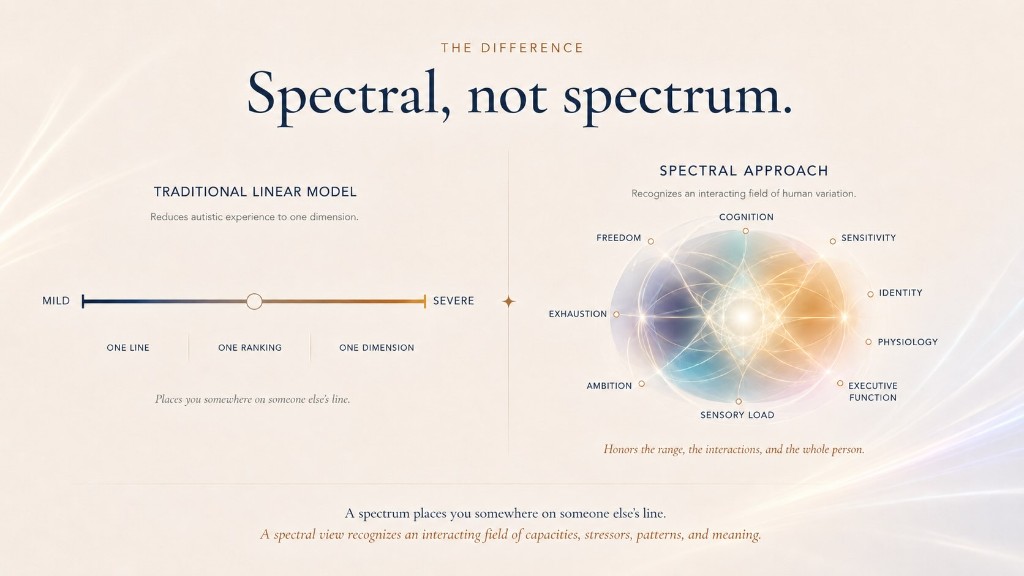
This work may fit if…
- One or both partners have ADHD, autism, or suspected neurodivergence.
- A late diagnosis has disrupted the relationship’s existing roles.
- You are a high-performing couple whose private relationship feels much harder than your public life suggests.
- You understand the issues intellectually but repeat the same behaviors.
- Both partners are willing to examine their contribution to the pattern.
- You want direct feedback, practical structure, and observable change.
This may not be the right setting if…
- There is active coercion, violence, or fear for either partner’s safety.
- One partner is participating only to prove that the other is the problem.
- Either partner requires emergency or crisis care.
- The immediate need is stabilization that should occur in individual treatment first.
This practice does not provide crisis services. If you are experiencing a mental health emergency, please call or text 988 or go to your nearest emergency room.
Find the right door.
Couples therapy
For couples experiencing clinical distress, burnout, anxiety, or relationship patterns requiring licensed therapeutic care.
Licensed in California and Georgia — in-person and virtual in California; telehealth only in Georgia.
Book a consultation →Couples coaching
For appropriate couples seeking structured work around communication, responsibilities, leadership, transitions, or relationship design.
Coaching is not a substitute for therapy when clinical care is needed. Fit is discussed during the consultation.
Book a consultation →Relational Calibration Cohort
A guided group environment for neurodivergent adults working on communication, emotional intensity, and repair across important relationships.
Participants join as individuals; this is not couples therapy conducted in a group.
See the cohort →
Direct, structured, and human.
Michel Bordeau, MA, LCSW developed The Spectral Method from clinical practice, developmental psychology, DBT, logotherapy, lived experience, and years of observing where insight alone fails to change a life.
His role is not to determine which partner is right. It is to help both people see the pattern clearly enough to make different decisions inside it.
Common questions
Do both partners need an ADHD or autism diagnosis?
No. A formal diagnosis is not required for either partner. Michel works with diagnosed and self-identified adults. Whether this work fits the two of you is discussed during the consultation.
What if only one partner identifies as neurodivergent?
The work may still fit. One or both partners may have ADHD, autism, or suspected neurodivergence. Both people still need to be willing to examine their contribution to the pattern. Fit is discussed during the consultation.
Is this couples therapy or couples coaching?
It can be either, and they are different doors. Therapy is for couples experiencing clinical distress, burnout, anxiety, or relationship patterns that need licensed care. Coaching is for structured work around communication, responsibilities, leadership, transitions, or relationship design. Coaching is not a substitute for therapy when clinical care is needed. The consultation is where that distinction gets made.
Where must we be located for therapy?
Licensed therapy is available in California and Georgia. California clients can meet in person in the San Diego County area or by secure video anywhere in the state. Georgia clients are seen exclusively via telehealth — there is no in-person office in Georgia. We confirm format in the consultation. If partners live in different states, or outside California and Georgia, we’ll discuss fit and eligibility during the consultation.
Do you work with married and unmarried couples?
We’ll discuss fit and eligibility during the consultation. This work is described for adults in long-term relationships.
Do you work with LGBTQ+ couples and different relationship structures?
We’ll discuss fit and eligibility during the consultation.
What happens during the first consultation?
It is a complimentary 30-minute conversation about what keeps happening, what kind of support you want, and whether Michel is the right person for it. You do not need a polished explanation. You leave with a clear next step — a time to schedule, a waitlist, or a direct referral elsewhere.
Will you tell us which partner is right?
No. The work is not to decide who is the problem. It is to separate what happened, what each partner believes it means, and what must change next.
What if one partner is unsure about participating?
Say so in the consultation. This setting asks both partners to examine their contribution to the pattern. If one person is participating only to prove the other is the problem, it is not the right setting. We’ll discuss fit, and whether another form of support should come first.
How long does couples work usually last?
There is no standard length published for couples work. How often you meet, and for how long, depends on what the two of you need and can sustain. We’ll discuss that during the consultation.
Do you accept insurance for couples sessions?
Michel accepts insurance for telehealth sessions in Georgia and is private pay only in California. Whether couples sessions are billed the same way is confirmed during the consultation. After paid sessions, a superbill can be provided for you to submit if your plan includes out-of-network mental health coverage. Reimbursement is between you and your insurer and is not guaranteed.
Is this appropriate when there has been abuse or a safety concern?
No. This is not the right setting when there is active coercion, violence, or fear for either partner’s safety, or when either partner needs emergency or crisis care. This practice does not provide crisis services. If you are experiencing a mental health emergency, call or text 988 or go to the nearest emergency room.
Rates, insurance, and session format are outlined on the FAQ & fees page. Location detail is on the California and Georgia pages.
You do not have to solve the relationship before asking for help.
A 30-minute consultation is a chance to describe what keeps happening, understand which form of support may fit, and decide whether Michel’s approach is right for both of you.
Book a 30-minute consultationComplimentary. No preparation or polished explanation required.